Years of state tax cuts for the wealthy and corporations mean local communities are left with the difficult choice of raising taxes to fill the gap – or leaving Missourians without essential services that enable families to thrive and stimulate local economies.
Over the past decade, Missouri state lawmakers have enacted a series of tax cuts that, when fully implemented, will reduce state general revenue by nearly $4 billion each year. This hampers Missouri’s ability to invest in critical services (such as public schools and supports designed to keep older adults in their homes and communities), and it passes the buck to local communities.
As the state disinvests, local communities have compensated with sales and property tax increases to help fill the gap in services – making Missouri’s tax code even more upside down.
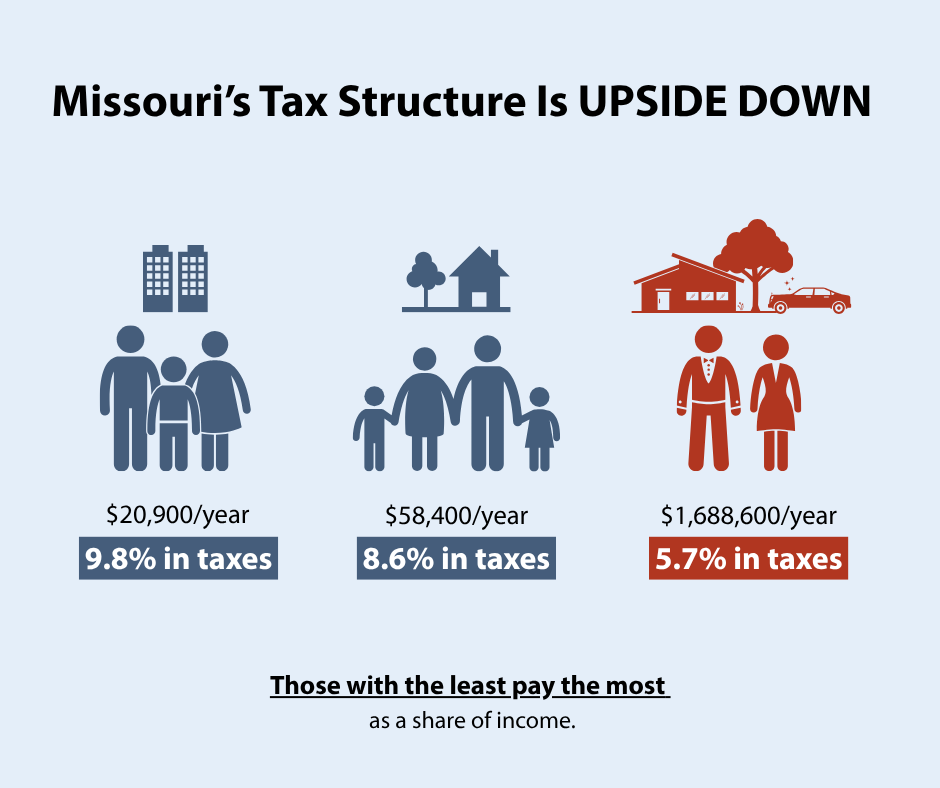
Missouri already has an upside-down tax structure, where Missourians earning the least contribute a higher share of their incomes than Missourians earning the most.
When the state enacts tax cuts that most benefit wealthy Missourians, it shifts taxes to the local level – and shifts responsibility for funding services to low- and middle-income families.Missouri strictly limits what taxes local communities can use to fund services.
– Missouri strictly limits what taxes local communities can use to fund services.
– Most communities are forced to rely heavily on sales and use taxes and property taxes.
Recent sales and property tax collections illustrate this trend:
Sales Taxes
Over the past decade, state sales and use tax collections grew by 18%, while local collections grew by 32%.
Missouri’s average local sales tax rate is now higher than all but five states in the nation.[i]
Property Taxes
While Missouri’s property tax rates are moderate compared to most other states, there have been dramatic increases in recent years.[ii]
In 2025, over 90% of Missouri’s counties saw property taxes increase faster than inflation.[iii]
Local communities increasingly rely on earmarked sales taxes and property tax levies to fill gaps in critical services.
Special taxing districts fund services for children, older adults, people living with disabilities, fire protection, emergency services, zoos and libraries. They are an important way to address the unique needs of local communities and are a central component of an balanced revenue system. But special taxing districts work best when they are a complement to, not a replacement for, state investment in critical services.
– Missouri has more special taxing districts than all but one other state in the nation.[iv]
– Between 2015 and 2024 the number of sales tax districts increased from approximately 500 to 800, a 60 percent increase.[v]
State income tax cuts for the wealthy and corporations shift responsibility for services to local communities, resulting in a patchwork of services and opportunities.
– Only two states in the nation collect less state revenue per capita than Missouri.[vi] This means Missouri’s investments in its citizens have now fallen well behind – both as compared to other states and where we were in prior years.
– Not all local communities are able to fill that gap, meaning that services vary dramatically depending on where a Missourian happens to live. Rural communities and underserved neighborhoods in the urban core — often the places with the greatest need — simply cannot make up the difference.
A Spotlight on Missouri Public Schools
Missouri’s low state funding means that school districts rely heavily on local property taxes.
– Missouri provides a lower share of state support for public schools than all but one other state in the nation.
– Nearly 2/3 of funding for public schools in Missouri is local, a higher share than all but two states and well above the national average of 42%.
_______________
High poverty districts that need the most resources to educate students have the least ability to fill gaps in funding with local resources.
– Missouri’s highest poverty districts receive $3,023 (or 18%) less funding per student than more affluent districts.
– Only two states in the nation have a larger gap in funding between high and low poverty school districts.
Sources
NEA Rankings of the States 2024 and Estimates of School Statistics 2025
Education Law Center. Making the Grade 2025: How Fair Is School Funding In Your State?
[i] Tax Foundation. State and Local Sales Tax Rates, 2026. Accessed April 21, 2026. Available: https://taxfoundation.org/data/all/state/sales-tax-rates/
[ii] Missouri’s effective property tax rate of .89% is lower than 22 other states and higher than 27 states. Tax Foundation. Property Taxes by State and County, 2026. Accessed April 21, 2026. Available: https://taxfoundation.org/data/all/state/property-taxes-by-state-county/
[iii] Missouri State Auditor. 2025 Property Tax Rates. Accessed April 21, 2026. Available: https://auditor.mo.gov/AuditReport/ViewReport?report=2026006
[iv] Tax Foundation. How Many Sales Tax Jurisdictions Does Your State Have?. Accessed April 21, 2026. Available: https://taxfoundation.org/data/all/state/state-sales-tax-jurisdictions-in-the-us-2020/
[v] Missouri State Auditor. Department of Revenue Sales, Use, and Marijuana Taxes. Accessed April 21, 2026. Available: https://auditor.mo.gov/AuditReport/ViewReport?report=2026024
[vi] Missouri Senate Appropriations Committee. 2025 Annual Fiscal Report. Fiscal Year 2026.