While Missouri’s FY2027 operating budget cuts critical services, legislators used several one-time budgetary tricks this year and largely avoided the difficult decisions needed to address the state’s ongoing budget shortfall. Line-item vetoes and budget restrictions are likely in FY2027, with even deeper cuts likely in FY2028.
Missouri’s FY2027 operating budget totals $49.88 billion, plus an additional $5.53 billion for capital improvements projects. This budget includes painful cuts to education, senior services, and other critical services, but avoids even more painful cuts that would address Missouri’s ongoing $2 billion budget shortfall – primarily by cobbling together a range of one-time and temporary funding sources to pay for ongoing services.
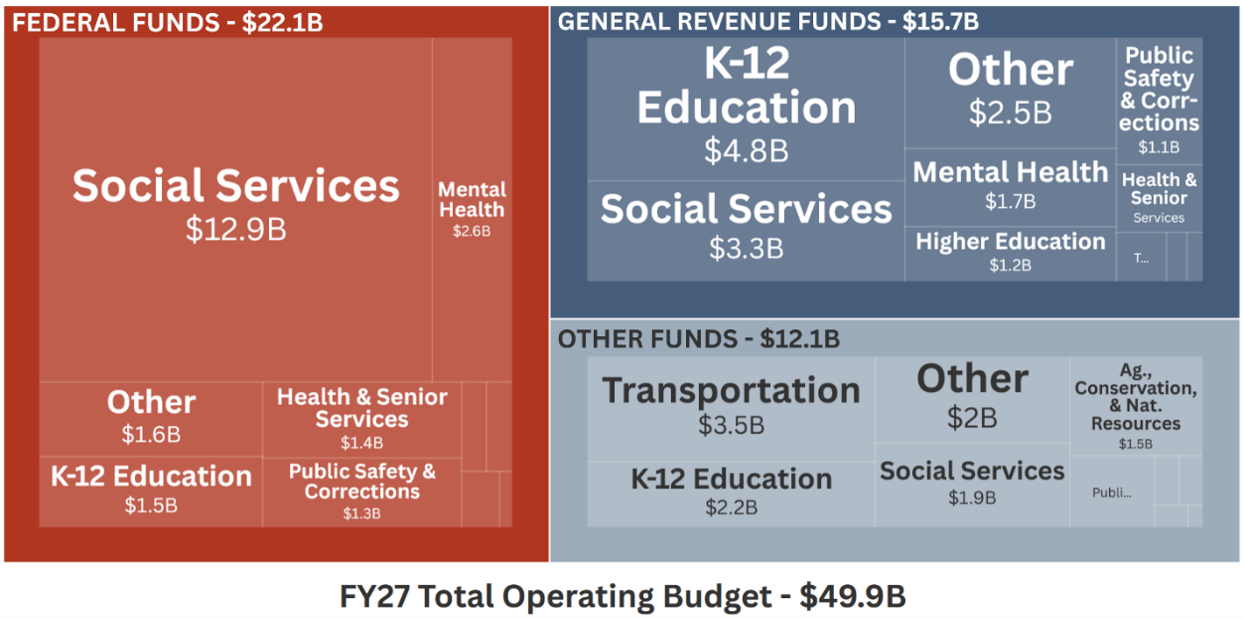
Missouri’s General Revenue budget makes up about a third of spending at $15.70 billion. However, the state estimates Missouri will generate only around $13.65 billion in general revenue in FY2027.[i]
This difference between estimated revenue collections and the budget creates a gap of over $2 billion.
This gap is the culmination of years of tax cuts, heavily weighted toward the wealthy and corporations, which have eaten into Missouri’s general revenue budget. While a strong economy and extraordinary federal funding tied to COVID temporarily masked the full impact of these tax cuts, Missouri is finally feeling the impact of this massive revenue problem.
Many critical services face cuts or flat funding in the FY2027 budget.
- Missouri’s K-12 schools were underfunded by $190 million with an additional $17.15 million cut to school transportation; this is the first time K-12 education was not fully funded in nearly a decade.
- Missouri’s Area Agencies on Aging received a 20% cut to the Senior Services Growth and Development Program (SSGDP), a flexible funding source that pays for the infrastructure (such as kitchens & vans) needed to deliver meals to older adults.
While several proposed cuts were eventually restored in the final budget passed by lawmakers, these services still face significant risk of cuts moving forward.
- Significant cuts to services such as childcare subsidies and programs for Missourians with developmental disabilities were initially proposed, with funding restored in the final budget.
- But even items that were restored are not safe from cuts moving forward; line item vetoes and budget restrictions are widely expected given that the FY2027 budget counts on NOT spending $1.137 billion of the funding that lawmakers appropriated.[ii]
Lawmakers largely avoided addressing Missouri’s ongoing revenue shortfall and instead relied on budgetary tricks to make the budget whole.
Lawmakers heavily relied on temporary and uncertain sources of funding to close gaps in the state budget, meaning that these sources of revenue are unusual, largely one-time, and will not be available to fill gaps in next year’s budget.
- Blind Pension Fund: The budget uses over $72 million from the Blind Pension Fund to close gaps in funding for K-12 schools. Combined with appropriations for actual pension payments, that means over $112 million is appropriated from the blind pension fund which currently has a balance of only $86 million – a difference over nearly $30 million.[iii]
- Capitol Preservation Fund: The budget also taps into a fund set aside for expansion and renovation of the Capitol Building to pay for several items including $89 million to fund public schools ($74 million to the K-12 Foundation Formula and $ 15 million for school transportation).
- Lottery & Gaming Funds: Missouri’s K-12 schools are funded in part by earmarked taxes on lottery and gaming proceeds. The Department of Elementary and Secondary Education (DESE) has indicated that these funds are unlikely to meet projections,[iv] meaning that only part of this funding is likely to be available to support education in the coming year.
- COVID Savings: During COVID lawmakers set aside billions in general revenue generated as a result of temporary enhanced federal funding. The FY2027 budget relies on more than $2 billion in remaining savings to fund services, including $150 million set aside from COVID stimulus funds to cover potential shortfalls in earmarked funding for public schools.
[i] Fiscal Year 2027 Executive Budget. Accessed 6/4/26 https://budplan.oa.mo.gov/media/pdf/fy27-executive-budget.
[ii] Missouri State Auditor (June 2026) Analysis of General Revenue Fund Financial Condition Follow-up
[iii] Office of Missouri State Treasurer Monthly Fund Activity May, 2026. Accessed 6/2/26 https://treasurer.mo.gov/bank/FundReport/2026/MonthlyFundActivityReport_May2026.pdf.
[iv] Missouri Senate rejects increase to school funding despite shortfall in state payments. Accessed 6/18/26
https://missouriindependent.com/2026/04/23/missouri-senate-rejects-increase-to-school-funding-despite-shortfall-in-state-payments/